Ruby:
Hello, welcome. Thank you so much for being part of this interview. I noticed on your social profile that you call yourself a feminist photographer. What does that that mean to you?
Ge:
So, I personally identify as a feminist. I started identifying as a feminist in 2019, when someone told me that I don’t need to be a perfect activist of women empowerment to claim the feminist personality. And starting then, I also developed my interest in photography. During the pandemic, actually in 2020 when the pandemic started, I started an Instagram page (my personal Instagram page), where I took self-portraits of myself, because it’s been so long that we weren’t able to get out to dress up. I wanted to have an excuse to do a photo shoot or something like that. It started as something vain like that, but then I realized maybe this is an opportunity to also work on my body-image issues. That’s why I started it. Instead of trying to make it more posey or more edited, I tried to stay away from editing the photos too much, or from posing too much or being too conscious about my body fat, whenever I took photos of myself.
Ge:
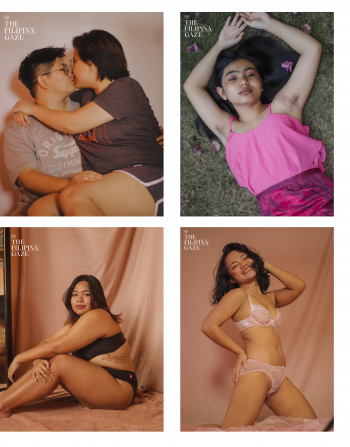
And then this year, because the restrictions were eased with the pandemic (there was already a vaccine), I started asking to shoot models because Instagram is a platform that’s very aesthetic, wherein their beauty ideals are really upheld. And I wanted to be the kind of photographer that makes people, especially women, comfortable with themselves. So, that’s why I’m branding myself as a feminist photographer because I know the experience of being the one behind the camera. You’re shy, you’re like—Am I ugly? I don’t feel good being shot like this. I wanted to go be the photographer and make sure that the women I shoot are comfortable with themselves. So, I think some factors that make a photograph a feminist photograph is when it’s shot by a woman photographer, or someone who empathizes or understands the struggles of the actual people being shot in the photographs. And then the people in the photo are people who are often not represented in mainstream media. So, these are the people who we don’t see in television or in famous Instagram accounts. They’re not the typical aesthetic or beauty ideals that we have.
Ge:
So, promoting these images and empowering these people and these women helps empower me also as a photographer—and hopefully when I post it on a social app like Instagram, it empowers the viewers or my audience. I think that’s the core of what being a feminist is. That’s why I really call myself a feminist photographer and I try to really apply whatever feminist values I can when doing photo shoots.
Ruby:
One thing that I love about your photography is how it (the subject) can feel like your neighbor, or a friend of a friend. It feels very real, with real women, and it totally makes sense with what you just shared. So, thank you. I love your style of photography.
Ruby:
And another thing that is really inspiring is your body advocacy, and you shared that it really started with yourself. What was that like for you to learn that that was something that you wanted to improve for yourself, and then to be able to speak up about it?
Ge:
I think, because ever since I was a kid, body ideals were already pressured on me. Either I was too fat, and then when I got on diets and I’d get thin, instead of praise, people would still say, “Oh, you’re so thin. Do you still eat something?” So, whatever kind of body I have, people will always have something to say about it because, I don’t know, maybe it’s mostly because I’m a woman, and there are ideals for us. I don’t know, it was really just during the pandemic, because pre-pandemic, I was really into dieting. I was really starving myself, just so I could become thin. And then during the pandemic, I kind of had started going to therapy, and started taking care of my mental health. I had to take antidepressants and other medications. And that’s when I started to gain weight, really. I gained almost ten kilograms this year because of the medications I took.
Ge:
And I was so really depressed. I got better in my mental health, but at the same time, there’s this part, it’s like—But I gained weight. So, there’s a part of me that’s like—Which is more important, your physical health or your mental health? And I realized that it’s not even physical health because I just wanted to starve myself and become thin. Since I’m studying a master’s degree in women development, I know the theories. That these are all just pressures by the patriarchy and society to oppress women, and that I should not care about how I look. But even though I know that theoretically, it’s so hard to let go of that feeling that I need to make myself look better.
Ge:
So, I don’t know, this year with the help of photography, I challenged myself to be like—Okay, take photos of yourself, even if it’s not super good, even though you hate it. My partner also helps me in my photography. He reminds me like—Oh, don’t edit it. Don’t tuck in your tummy too much because it’s really obvious—and things like that. So, I think it really started with my photography since I was able to see myself.
Ruby:
And it’s not just body advocacy that you share with the world, you are also embracing topics like sex and sexuality, that are still taboo in a lot of places. What was that like for you to be able to talk about that sort of thing?
Ge:
It’s quite difficult. Because until now, Instagram is kind of like my safe social media space because I have a Facebook account and I used to like, whenever we go to the beach, of course I post bikini photos and then I get online sexual harassment and things like that. So, I turned to Instagram since there’s less—well, in my experience there’s less—harassers. Though, I still get messages and forms of sexual harassment once in a while. It’s difficult to talk about issues of sex and reproductive health, especially in the Philippines since we’re also a very conservative country. And it’s really difficult because I have always been told that I shouldn’t dress provocatively or shouldn’t post certain pictures or certain photos. And that really bothered me because I see a lot of guys posting shirtless or something like that. And people don’t comment on that or say that’s something immoral.
Ge:
So, one of the first things I posted about sex and other reproductive health was about sexual violence. Which was like, I love posting lingerie photos, but that doesn’t mean I’m asking for it. So, it’s like, these are photos that I took of myself because they make me feel good about myself, because I see myself and I’m like—Wow, that girl is so good. Those are the few times that I really appreciate or fall in love with my body, and I’m sharing that feeling with the world. And that doesn’t mean I’m asking for sexist comments or any kind of harassment. Because of Instagram, I’ve met a lot of people who were like—Oh, I relate with you. They are strangers or acquaintances that I have never met in real life, but they were always so supportive.
Ge:
And they were, I guess, the reason that I got the confidence to post more content like that because I was like—Okay, I don’t care what the male people see as long as there are these fellow women who are supportive of what I do and that will be okay for me. And that’s really my goal.
Ruby:
You also use another creative medium, and that is writing. And you talk about your experience as a woman through your writing. I imagine it to be a very reflective experience for you. What does writing do for you and what are you hoping to achieve from it?
Ge:
I try to reflect or try to be as honest and as real as possible whenever I write—especially if it’s hand in hand with the photos that I post. It’s still difficult because I know that there are personal things that I don’t want to share with the whole world yet. So, I try to write in a way that is as honest as possible, but at the same time, protecting my own story and sharing only part of my own story, since I’m not yet super ready to share everything in my life. Writing really helps me. Sometimes I write random notes if I think of something, if I remember an experience, because usually there are flashbacks. It’s like, there are times when you randomly remember a bad experience or a bad encounter, like a catcall, abuse, or something like that. Those are the times when I really get in the mood to write.
Ge:
Sometimes the writing thing comes first before the idea for the photo. I write long paragraphs as captions for my photos because they share the story that I want to share to my fellow women who have experienced the same things that I have. And when writing, I try my best to always end it with a call to action. So, it’s not just sharing my experiences, but recommending or encouraging people to do a certain thing—to reach out if they need help, or fight back when they can, things like that. Because I don’t want it to end just as my story, I want it to be something that is helpful to my audience as well.
Ruby:
If you want people to take one thing away from your creative content, what would you want them to be inspired by? Or what would you want them to learn?
Ge:
Right now, what I really want people—well, my women, fellow women—to know, or to take away from my content is that they should always support other women in whatever ways they can. And sometimes I feel like it’s such a small thing, what I do. I’m having a hard time right now during the pandemic to go to communities and actually photograph them. But I’m hoping that as soon as the pandemic is over, I can get to photo shoot the more marginalized people. So, I guess that’s what I want. That’s my goal, really, to encourage every woman to help other women. Because in the end, we’re the ones who are oppressed—and the only way we can throw over the patriarchy is when we help each other out, and we unite as a group. So, let’s not turn on each other and let’s always be supportive of each other and help each other, whatever way we can. So yeah, that’s always my goal.
Ruby:
That’s beautiful. And I see that you do fashion as well. I know you talk about the importance of sustainability a lot in your social channels. Why is that important for you?
Ge:
I’m also a fashionista, I like dressing up. And growing up as a child, I always thought that branded clothes are always the best. But since we couldn’t always afford those kinds of clothes, we would always go to ‘ukay-ukay.’ Those are the secondhand thrift stores of clothes here in the Philippines. I used to be ashamed of that, of going to ukay-ukay. But then when I got older, I realized that doing thrifting is actually more helpful to the environment, and that I actually can find very pretty vintage pieces as well. So, it’s like I’m a treasure hunter of some sorts. My previous work was also with a trade union, and there I was able to understand the impact of fast fashion on garment workers, aside from the environment. It’s really shocking and heartbreaking what’s happening to them. So ever since then, I really started being more active in the call for a more sustainable fashion movement.
Ruby:
What specifically would you like to do next, if anything?
Ge:
Last November, I launched my feminist photography (Instagram) page. I wanted to make it into a separate page instead of my personal page so that it’s not about me anymore, and it’s more about the women I photograph. So, I created The Filipina Gaze, or @thefilipinagaze. It’s a page where I post photos of the women I shoot. I made it into a gallery and I started doing my first exhibit during the 16 days of activism. The exhibit was about ‘si malakas ay si maganda,’ which means ‘beautiful is also strong’ (in Tagalog). I focused or highlighted women who are like me, who have their own focuses and who continues fighting for a gender equality despite the powerful patriarchy. And I hope to continue growing my photography page next year. I wanted to, aside from just shooting my friends, go on streets—meet women there, photo shoot them, learn their stories, then be able to share them with the world. So, I hope I’ll be able to do that next year.
Ruby:
I love that! I’m looking forward to seeing that. Thank you so much for taking your time out and talking with us.